Warm Glass, Cool Glass: Re-seeing the Terrarium’s Moss and Film - 適合進階的英文短篇故事,含中譯與發音
溫熱與清涼的玻璃:重新看見瓶中苔蘚與薄膜 | 英文/中文 雙語朗讀
ストーリー内容
English 原文
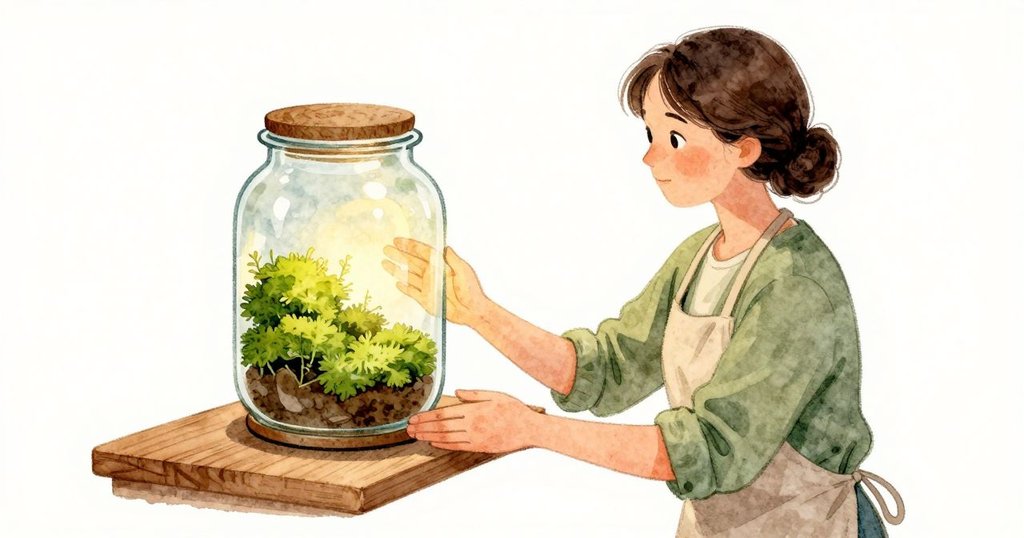
Ursula’s thumb found the jar’s warm curve while her other palm settled on the cool glass before her eyes even focused on the shelf.
Two fingers gave the base its tiny nudge, the bright patch sliding a finger’s width along the wall to reach the moss.
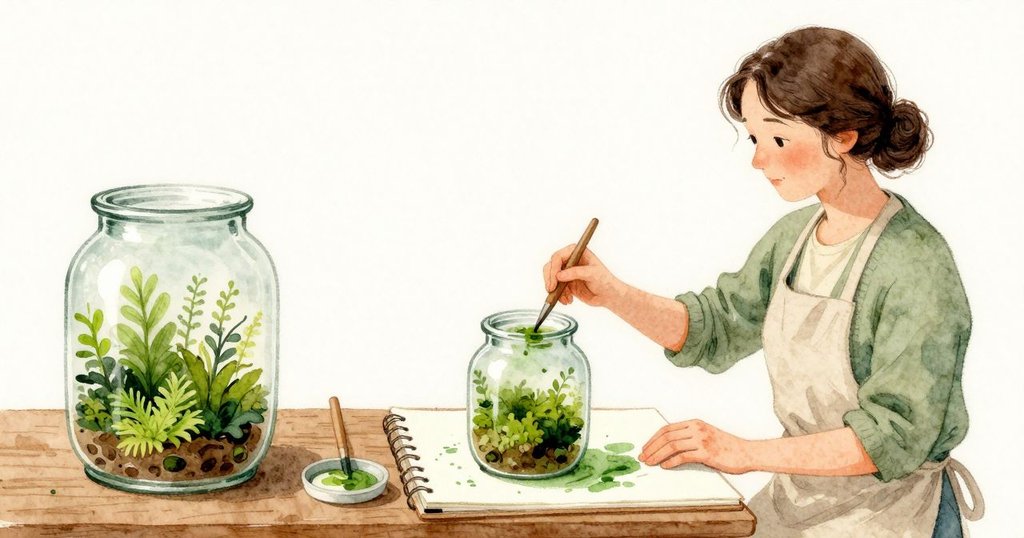
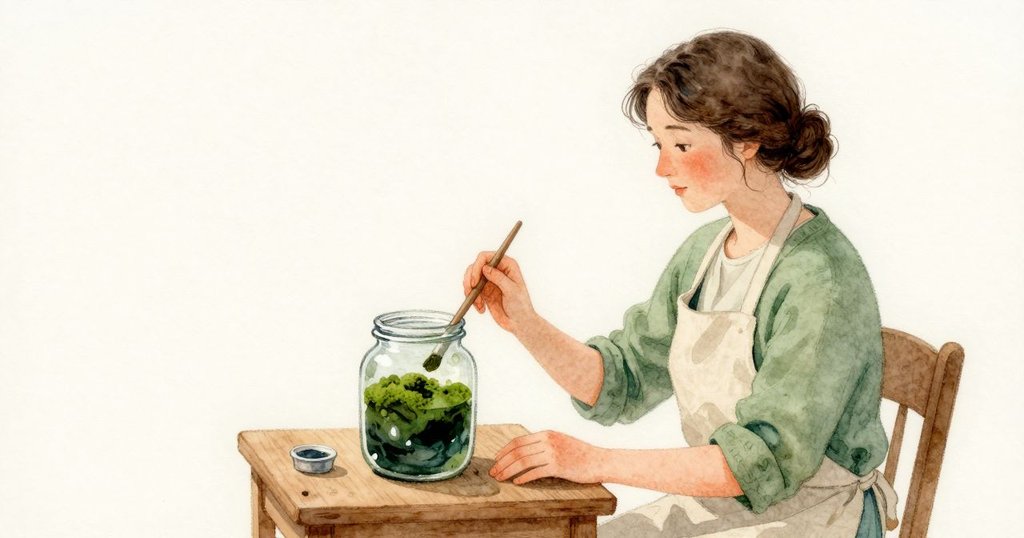
She set a sketch pad beside the jar, crushed green pigment into a wet well, and dragged a brush across the paper to meet the jar’s darker carpet.
The stroke dried lighter than the cushion it imitated, so she loaded more color and tried to press weight into the paper’s grain.
Her wrist slowed mid-line and hovered; the shade still refused to sit with the moss under the window’s longer burn.
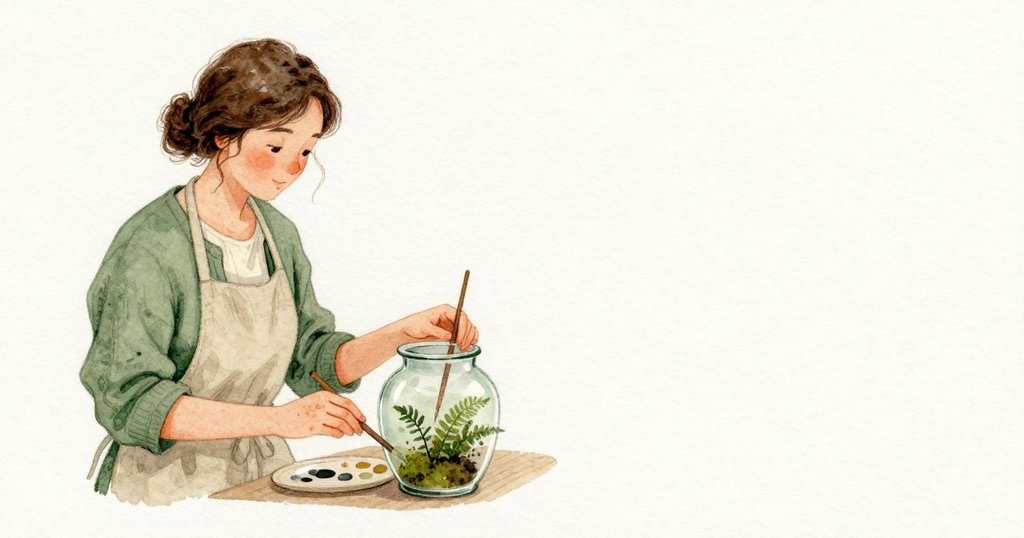
She mixed again, deeper and duller, and dabbed tiny ovals where the fern’s shadow should darken, yet the patch stayed thin against the glass’s density.
She laid the brush across the palette, let her fingers uncurl, and stepped back from the page.
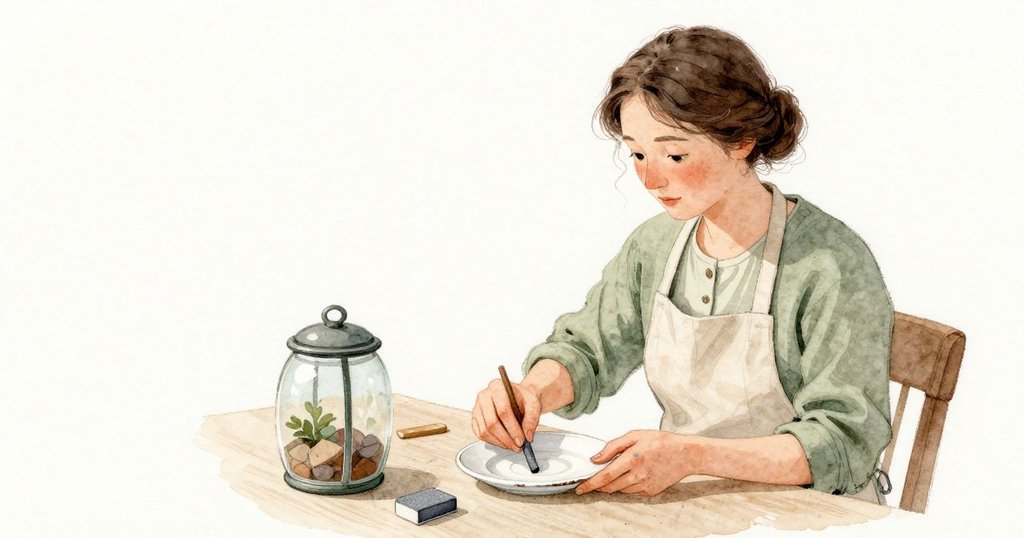
On the shelf’s end sat the white saucer that kept stray spills from the wood, its porcelain rim chipped into a grainy burr.
She pinched the saucer, found the rough place with her thumb pad, then reached for the narrow embry board from the drawer of small tools.
The first pass snagged; she reset the angle, drew the abrasive across the nick in shorter strokes, and watched chalky dust arc onto the table like a crescent.
Her other hand steadied the saucer; the board rasped a steady rhythm that matched the faint ticks inside the jar.
"Still ticking," she said quietly, her voice just a breath above the hush of the room.
When the rim smoothed, her thumb slid over it without catching, and a milky crescent of powder rested in the fold of her palm.
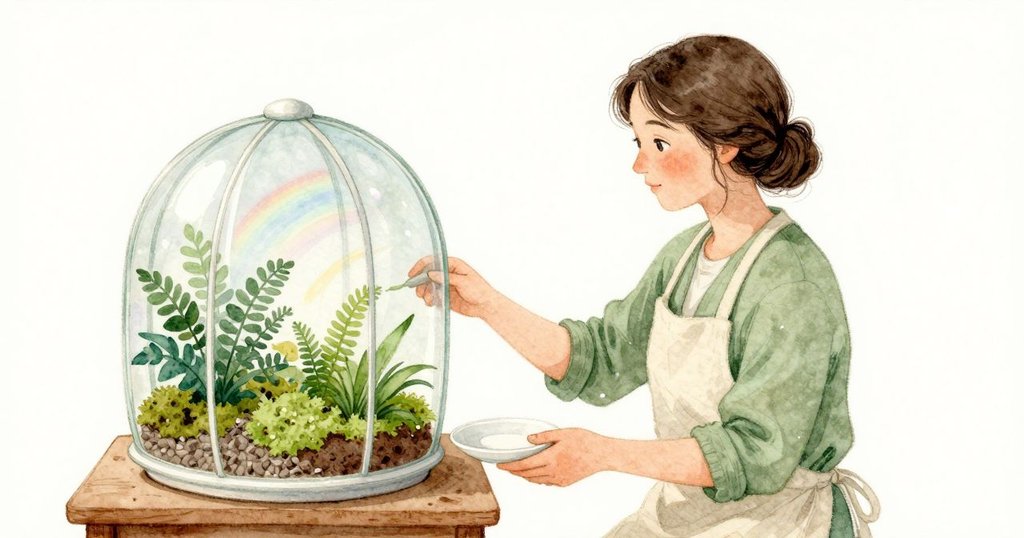
She brushed the dust into a line and noticed how the terrarium’s mineral film held faint rainbow bands that curved along the same sweep.
She moved sideways along the shelf, and the greens rearranged under the curve: denser where the window held them, paler where the glass bent light away.
The moss, fig, and fern sat in a quiet hierarchy—gravel below, peat above, then cushions and fronds—each spot wearing light differently, like a sleeve meeting its cuff.
Where a leaf pressed the wall, condensation beaded along its veins, grew heavy, and slipped down to tap the darker patch she had been trying to paint.
Her forearm paused above the abandoned brush, then turned instead to the jar, the palette’s muddied square of pigment catching the same shade as the densest moss.
"There," she murmured to no one at all, and her shoulders dropped a fraction as her grip loosened around the saucer.
She did not return to the page; she circled once more and stopped at the shaded side, where the film’s bands darkened like tide lines on clear glass.
Her palm met the curve again; the warmth had slid away, and a single drop traveled past her print and tapped the moss with a brighter note.
繁體中文 翻訳
Ursula 的拇指先找到瓶子的溫熱弧面,另一隻手掌貼上陰涼的玻璃,眼睛還沒對上架子上的焦點。
兩根手指輕輕一推底座,亮斑沿著內壁滑移一指寬,正好照到苔蘚。
她把素描本擺在瓶旁,把綠色顏料壓進濕潤的小格,再讓毛筆拖過紙面,想對上瓶中那塊更深的地毯。
那一道乾得比她要的墊子更淡,所以她又加了顏色,嘗試把重量壓進紙張的纖維。
她的手腕在半空慢了下來,停著;那一片色彩依舊對不上窗邊長照出的苔蘚。
她再調一次,更深也更灰暗,點上蕨影應該落下的小橢圓,可那塊色面仍舊顯得薄,敵不過玻璃後的稠密。
她把筆擱在調色盤邊,讓手指展開,從紙前退了一步。
架子端頭放著那只白色托盤,專門攔住潑出的水,瓷緣缺了一角,生出砂粒般的毛邊。
她夾起托盤,用拇指腹摸到粗糙處,接著從小工具的抽屜裡拿出一片細長的指甲銼板。
第一下卡住了;她重調角度,改用更短的行程拉過缺口,粉白的屑屑畫出一道弧線落在桌面。
另一隻手穩著托盤;銼板發出持續的沙沙聲,和瓶內微弱的滴答聲對上了節拍。
「還在滴呢,」她輕聲說,聲音只比房間的靜更高一口氣。
邊緣變得平順後,她的拇指滑過去不再被勾住,一抹乳白的粉末停在掌心的褶裡。
她把粉末拂成一條線,注意到玻璃內側的礦物薄膜也留著隱約的彩帶,沿著同樣的弧度延展。
她沿著架面側身移動,綠意在弧面下重新排列:靠窗的更密,光被折開的那一側更淡。
苔蘚、榕藤和蕨一起坐在安靜的層次結構裡——下層是礫石,上層是泥炭,再上去是墊狀和羽片——每一處以不同方式穿戴光線,如同袖口接上衣袖。
有片葉子貼著內壁,水珠沿葉脈聚集,變重,滑下來,點到她一直想畫到的那塊更深的地方。
她的前臂在被擱置的毛筆上方停了一瞬,卻轉向玻璃,調色盤上那塊攪到發灰的顏料方格正好扣住最濃的一片綠。
「在這裡,」她小聲對著空氣說,肩膀微微落下一格,抓著托盤的手也鬆了些。
她沒有回到紙前;她又繞一圈,停在陰面,那層薄膜的色帶像潮線一樣更濃地留在透明的玻璃上。
她的手掌再次貼上那弧面;熱已經移開了,一滴水從她留下的指印旁滑過,叩在苔蘚上,聲音更亮。
文脈の中の語彙
- burr
金屬或陶瓷邊緣上的毛邊、粗糙小凸起,會刮手或勾住東西。
“Her thumb paused at the saucer’s rim, where a tiny burr kept catching her skin.”
她的拇指停在茶托邊緣,那裡一個小毛邊老是勾住她的皮膚。
- hierarchy
層級結構;從下到上或由低到高的排列次序。
“Inside the jar, a quiet hierarchy stacked gravel, peat, then cushions of moss and fern.”
在玻璃罐裡,安靜的層級從碎石、泥炭,到苔蘚與蕨的柔墊依序排列。
- pigment
顏料;能賦予顏色的細粉或物質,常用於繪畫來調出需要的色調。
“On her palette, a muddied square of pigment finally matched the moss’s deepest green.”
在她的調色盤上,一小塊混濁的顏料終於對上苔蘚最深的綠。
- embry
(原文拼作 embry,應為 emery board)指細長的磨砂指甲板或小型砂紙板,用來打磨邊緣。
“She worked the emery board gently, shaving the chip to a soft, chalky curve.”
她輕輕用砂板打磨,把缺口修成柔和、帶粉屑的弧線。
- porcelain
瓷;質地堅硬細緻、通常潔白光滑的陶瓷材料。
“The porcelain saucer guarded the shelf, its bright rim catching a thin ring of light.”
那只瓷質茶托守在層板邊,明亮的邊緣接住一圈細光。
ティーチャーズスパーク
AIが教えるヒントを生成し、物語を教材として広げる手助けをします
Story Discussion - Ursula's Jar
從故事開頭對觸覺與視覺的描寫,說明作者如何用細節建構 Ursula 與瓶子的親密感?請列出至少三個具體感官細節並解釋它們的作用。
開放式參考答案
Details: 1) "thumb found the jar's warm curve" contrasted with "her other palm settled on the cool glass" — the warm/cool contrast creates an immediate tactile intimacy and richness. 2) "Two fingers gave the base its tiny nudge, the bright patch sliding" — the small, deliberate motion emphasizes careful, close attention. 3) "She set a sketch pad beside the jar, crushed green pigment...and dragged a brush" — the pairing of touch (crushing pigment, dragging brush) with visual matching connects bodily action to seeing. Together these details slow time, focus attention on minute gestures, and produce a quiet, concentrated intimacy between Ursula and the jar.
Ursula 在把托盤的邊緣磨平之後立刻回到畫紙繼續上色了嗎?
是非題參考答案
No. She does not return to the page; instead she notices the mineral bands, moves along the shelf, touches the jar again, and ultimately watches a drop fall onto the moss.
描寫從她拿出銼板磨托盤到最後一滴水落到苔蘚上的多步因果鏈:列出每一步並說明為何上一動作導致下一動作(包含物理或心理動機)。
開放式參考答案
1) She pinches the saucer and feels the rough chip — tactile irritation motivates repair. 2) She takes the narrow rasp and makes short strokes — the rasping produces chalky dust and smooths the rim. 3) The rasp's steady rhythm matches the jar's faint ticking — the shared rhythm draws her attention back toward the jar. 4) After smoothing, she notices the powder and the mineral film's faint rainbow bands — visual detail redirects her focus from fixing to observing. 5) She moves along the shelf and perceives how light arranges the greens — closer observation reveals condensation on a leaf. 6) A bead of water forms and slips down — the physical condensation, aided by the shifted attention, produces the final drop that taps the moss. Psychologically, small tasks lead to observation, which leads to new perception and the eventual physical event.
她輕聲說「還在滴呢」與之後的「在這裡」兩句話,在語氣與內心狀態上有何不同?這反映出她的什麼心理變化?
開放式參考答案
The first line, "Still ticking," (translated as "還在滴呢") is an observational, almost detached remark—she notes an ongoing, subtle sound and acknowledges the room's hush. The later "There," ("在這裡") is locating and resolving; it expresses a small satisfaction or closure when she finds the shade and the place she was trying to reach. Together they show a shift from detached noticing to focused resolution and quiet relief.
把瓶內的『薄膜和彩帶』視為象徵:在這個故事裡,它最可能象徵什麼?(請以一句短語填空)
填空題參考答案
the passage of time
作者如何利用句子的節奏、反覆的小動作與具體物件(如托盤、銼板、滴答聲)來建立文本的節拍與張力?請舉一到兩個句子或片段為例並分析其效果。
開放式參考答案
The prose uses short, deliberate clauses and repeated verbs of touch and motion (e.g., "She pinched the saucer..." "The first pass snagged; she reset the angle...") which create a measured, tactile rhythm. The recurring small sounds—"chalky dust arc," "faint ticks," "still ticking"—act like a metronome, syncing with physical actions (rasping, brushing, nudging). This close coupling of sound and movement heightens attention and builds quiet tension: small changes become significant, and the reader feels the cumulative weight that leads to the final bright drop.
Role Play - the moment before the drop
情境
場景定位在 Ursula 在書架邊緣處的那一刻:她剛用細銼把白色托盤的缺口磨平,拇指滑過不再勾住的瓷緣,掌心還留著乳白的粉末。她注意到玻璃內側的礦物薄膜呈弧形的彩帶,並且聽見瓶內傳來輕微的滴答聲。空間安靜,窗邊的光線讓靠窗的苔蘚更為濃密,另一側則顯得蒼白。此時她沒有回到畫紙前,而是停在陰面,凝視著那層像潮線般的色帶——一滴水正從葉脈滑落,將要敲在苔蘚上。 教學提示:一位學生扮演 Ursula,另一位學生擬人化扮演 Terrarium(或 Jar),模擬兩者之間的短對話或內心獨白。鼓勵使用故事中的具體感官細節(拇指的溫度、粉末的觸感、玻璃上的虹彩、滴答聲與最後一滴落下的輕響)來豐富表演。練習重點包括細緻觀察描述、用英語表達不確定與好奇(疑問句)、以及短暫的停頓與沉默處理,以捕捉文本的節奏與氛圍。
角色
開場白建議
- •“I smoothed the saucer and felt that chalky powder—did you feel the warmth where my thumb was?”
- •“It's still ticking under the mineral bands; I'm watching a drop slide down. Are you ready for it to land?”
Creative Writing - Retrospection
寫作提示
任務說明:以 Ursula 的視角做一次回顧(retrospection)。讀者已知她在書架前磨平托盤邊緣、調色、試圖畫出瓶中苔蘚與蕨影,並聽見瓶內的滴答聲。現在請學生用英文寫一段大約 150 字的續篇,從回憶或年後重訪這個場景的角度出發,著重感官細節與內心因果(為何那一刻對她重要、滴答聲對她意味著什麼)。請鼓勵學生在文中使用下方單字庫的若干詞彙,並保持語氣溫柔、安靜、沉思。 教師示範(作為參考,非學生答案;以本故事語氣延伸,繁體中文示例,大約相當於 150 英文字數): 多年前的那個午後常常回來到我腦裡,像瓶內的彩帶一圈圈重疊。那天我把拇指放在瓷托盤的毛邊上,銼出一條像月牙的粉屑,手指的溫度留在破口邊緣。瓶裡的滴答聲在寂靜的房間裡像心跳,苔蘚受光的地方亮得像一塊布的褶皺。我沒有立刻回到紙前;相反地,我靠近玻璃,聽那滴答,讓顏料在調色盤上變得黯淡。多年後,我再打開那個櫃子,指尖還會記得玻璃的冷與熱交替,水珠的聲音比記憶更清晰。那聲音提醒我:有些畫面不只是被看見,更是被等待,而等待本身就是一種完成。
詞彙庫
寫作輔助
- • Years later, I still remember the sound of the ticking when...
- • My thumb found the warm curve and I thought about how...
- • I did not return to the paper; instead I lingered by the jar because...
- • The moss felt different that day — it seemed to say...
- • When I smoothed the saucer's edge, I realized that...
- • The tiny drop tapped the moss and it reminded me of...
Vocabulary & Grammar Focus
重點單字
jar
玻璃容器;文中指放有植物與水氣的玻璃瓶,帶有溫熱的弧面。
Ursula's thumb found the jar's warm curve before her eyes focused on the shelf.
moss
苔蘚;瓶內的綠色墊狀植物,是她描繪的主要紋理之一。
A single drop tapped the moss with a brighter note, breaking the room's hush.
palette
調色盤;用來混合顏料的平面,文中有一塊攪到發灰的色格。
She laid the brush across the palette, the muddied square catching the moss's tone.
crescent
弧形或新月形;此處指掌心粉末形成的乳白弧線。
A milky crescent of powder rested in the fold of her palm like pale moonlight.
saucer
淺盤或托盤;放在架端以接住潑落物,瓷緣有崩掉的毛邊。
On the shelf's end sat the white saucer that kept stray spills from the wood.
ticking
滴答或節拍聲;指瓶內微弱的滴答聲,與銼板的節奏相合。
The board's rhythm matched the jar's faint ticking, and she listened without moving.
film
薄膜;玻璃內側的礦物薄層,呈現沿弧度延展的隱約彩帶。
The terrarium's mineral film held faint rainbow bands along its curved sweep.
patch
斑塊;她試圖描繪的那塊較深的苔蘚色面,是畫面的焦點之一。
She kept returning her brush to the darker patch she had been trying to paint.
文法重點
語法重點:過去完成進行式(past perfect continuous)的用法與語感說明。 說明要點:過去完成進行式用形式 "had been + 現在分詞(V‑ing)",表示在過去某一時間或另一個過去動作之前一直持續進行的動作,強調動作的持續性或重複性,而不是單純的完成與否。作者在文中利用此結構(例如 "the patch she had been trying to paint")來突出 Ursula 長時間的努力與延續性,並把那份持續的嘗試與突如其來的外在事件(像是一滴水落下)形成對照。 辨識與轉換提示:看到 "had been + V‑ing",就尋找兩個過去時間點:一個是正在進行的較長動作;另一個是打斷或標記該動作的過去事件。若要把簡單過去句改為過去完成進行式,通常需把焦點從動作結果轉移到動作的持續過程上(例如把 "She tried to paint the patch" 改為 "She had been trying to paint the patch")。
練習題
On the shelf’s end sat the white ___ that kept stray spills from the wood.
參考答案
saucer
配對以下單字與意思:
顯示答案
A-7B-8C-4D-2E-3F-1G-6H-5
Where a leaf pressed the wall, condensation beaded along its veins, grew heavy, and slipped down to tap the darker patch she had been trying to paint.
參考答案
She had been trying to paint the darker patch when a drop slipped down and tapped it.
Cultural Connection - 微型生態瓶(苔蘚瓶)
主題
微型生態瓶(苔蘚瓶)
討論要點
- •故事裡,Ursula 把玻璃瓶當成繪畫與觀察的對象:她注意到瓶子的溫熱弧面、內側的礦物薄膜和彩帶,還聽到瓶內微弱的滴答聲。想一想:你曾經有沒有把某個小物件當作靜心觀察或創作的主題?描述你觀察到的三個細節(例如光線、觸感、聲音或色彩)。
- •故事描繪了苔蘚、榕藤與蕨的分層(礫石、泥炭、墊狀、羽片)以及窗邊光線如何讓顏色密度不同。回想你熟悉的室內植物佈置:它們如何根據窗位或光線改變樣貌?請寫下一個具體例子並說明光線的影響。
- •Ursula 用白色托盤接住水滴、用銼板修整破損的瓷緣,並留意水珠沿葉脈滑下的聲響。在你的生活裡,人們通常如何處理有缺口或髒污的器皿與托盤?是修補、重用還是丟棄?討論你的觀察並說明選擇的理由。
文化比較
在故事呈現的英文日常裡,微型生態瓶既是藝術觀察的對象,也是日常照護的個人儀式:Ursula 在玻璃的溫熱弧面上感受指印、在礦物薄膜和彩帶間捕捉色度,還聽著瓶內的滴答聲,這種細緻且私密的互動更像是一場單人的工作室練習。對照到繁體中文的生活場景,類似的小型植物展示(例如苔玉或小型盆栽)同樣重視層次材料與光線擺放,但它們常被置於窗台、陽台或茶几上,成為家居佈置與親友間交流照護經驗的日常物件。兩者的共同點是對光、濕度與材質細節的敏感;差異則在於社會功能與表現方式:故事中的苔蘚瓶更偏向個人觀察與創作的靜態物件,而在繁體中文的場域,這類植物容器也常承載家庭互動、手作技藝或傳承的用途。
Comprehension Quiz
1. When Ursula first touched the jar, what did she feel?
2. How did the bright patch move when she nudged the base?
3. Why did Ursula add more pigment after her first stroke?
4. What tool did Ursula use to smooth the saucer's chipped rim?
5. What sound matched the rasp of the emery board?
6. What did Ursula notice about the mineral film on the terrarium?
7. How were the plants arranged inside the jar?
8. What happened after Ursula smoothed the rim and touched the glass again?
おすすめの読み物
Watching a Glass Terrarium Through a Pocket Microscope
Shell in the Sunlight: Dust Brushed Away at the Fossil Bed
Old Nest and Pot Bubbles in One Beat
Tilted Jar, New Drip Map
Turning the Amber at the Lamp, Finding a Tiny Wing
Butterfly at the Clay Tray: A Vent Turn in the Greenhouse
A Bubble Rises Inside the Lacquer Panel
Where the Droplet Paused
Amber Pebble, Then a Clear Window in Daylight
Lilac Bloom on Water
The Quarter-Turn on the Birch Log